
University of California’s Math Preparedness Crisis Spurs Search for Answers and Solutions
How UC Campuses and at least one O.C. School District are Responding
This story was originally published by EdSource. Sign up for their daily newsletter.
Top Takeaways
- The University of California’s Board of Admissions and Relations with Schools is set to meet Friday as it continues to weigh whether to recommend reinstating standardized exams in admissions.
- The admissions board will review reports that give more context to student performance at UC, including the growing failure rates in calculus and other introductory math classes.
- Campuses are simultaneously working to address math readiness as they expand tutoring and other support services. They are also redesigning courses and rethinking whether all students in science programs need calculus.
The University of California is facing a pivotal moment in its high-profile deliberation over whether to reinstate the SAT and ACT admissions requirement in response to students’ declining math preparedness.
UC’s Board of Admissions and Relations with Schools (BOARS) on Friday will review reports that more deeply explore the spike in the number of students failing introductory math courses at the prestigious public university system.
Meanwhile, UC campuses and math departments are searching for their own answers to help students catch up in math. They are redesigning courses, expanding counseling services and encouraging students to take summer classes if they are underprepared, especially if they did not take precalculus in high school.
Some campuses are also reconsidering whether students in certain science programs need to take calculus. UCLA, for example, has found success with a first-year math course tailored to students in biology programs.
The reports to the admissions board could chart how UC responds to calls for reinstating high-stakes testing for freshman admissions.
One report will provide more information on enrollment patterns and performance in introductory math classes, such as calculus and precalculus. UC recently revealed that, last school year, 18% of students in those classes failed or struggled greatly. (That figure doesn’t account for students who started in a higher math class or didn’t take math at all.)
BOARS will also review a report on how student outcomes, such as grades and graduation rates, have changed since UC eliminated standardized testing in 2020.
The admissions board is expected to make a recommendation by February on whether to bring back the SAT and ACT for first-year admissions. The UC Board of Regents will make the final decision, likely in the summer.
“The numbers aren’t where we want them. But it doesn’t necessarily mean that that’s the end of the story,” Pamela Brown, UC’s vice president for institutional research and academic planning, said of the failure rates in math courses.
A UC Berkeley alumnus, she recalled herself having trouble in math as an undergraduate before earning her bachelor’s degree in applied mathematics. “You can struggle in math, and you can still succeed at the university,” she said.
Can the readiness crisis be traced to high school?
UC is also investigating whether changes in high school course-taking patterns could help explain students’ preparation levels.
Across California, the share of high school students taking precalculus or calculus has steadily declined — from 45.9% of students in the class of 2017 to 33.4% of students in the class of 2024, according to a study this year by California Education Lab researchers. Neither course is required for UC admission, but some students take them to prepare for college-level math.
Those researchers are working with the UC president’s office to analyze course-taking patterns specifically among students who enroll at UC campuses. Their findings are not yet available.
At the same time, the share of California’s 11th graders who are proficient in math — 31.9% last school year — has remained below prepandemic levels.
Joel Hass, chair of the math department at UC Davis, acknowledged that more students are leaving high school unprepared for college math. Still, he said he supports reinstating the SAT and ACT, at least for certain math and science programs that require advanced math classes.
“It sends a signal not just to the campus, but also to the student, that maybe they aren’t prepared as they might think they are, and maybe they need to work hard to prepare for university coursework,” Hass said.
In August, the Capistrano Unified School District Board of Education discussed the issue during its public meeting. The district in southern Orange County has six comprehensive high schools. CUSD's graduating class of 2025 had more than 350 students enroll at UC campuses in the fall of 2025, according to the UC system.
At the August 13 board meeting, CUSD trustees unanimously adopted a resolution "urging the University of California to ensure evidence-based STEM admissions practices that promote student readiness and success."
The resolution does not advocate for the return of the SAT or ACT for admissions, but does acknowledge the decline in math preparedness among college freshman. It cites a UC San Diego report from 2025 that found more than a quarter of UCSD students who placed into a remedial mathematics course in 2024 had earned a 4.0 high school mathematics grade point average.
CUSD trustees Gila Jones and Jennifer Adnams discussed how the district's embrace of evidence-based grading could help address the problem.
"Students are being given extra credit for things that don't demonstrate learning. And so a student can get ... straight A's just by doing all this extra credit work or things that are not actually showing that they know the material," Jones explained. She said the extra credit boost happens less in science and math courses, but still might explain why a student with a high GPA may struggle academically in college.
"I think as we move to standards-based grading that is going to be much less of an issue and I think that colleges will be able to rely on our grades much more than they can now," Jones added.
Watch the Capistrano Unified School District board's discussion on the resolution on UC admissions.
"I think it's important that our evidence-based grading ... how we are working on that and growing that is important because the bottom line is it matters that these students are prepared when they get to college," Adnams said.
"The UC system has to take a look at how are they going to measure if students are actually prepared for their university and how are we doing in actually preparing them," she added.
Rethinking math instruction
Some UC campuses are trying to support struggling students sooner.
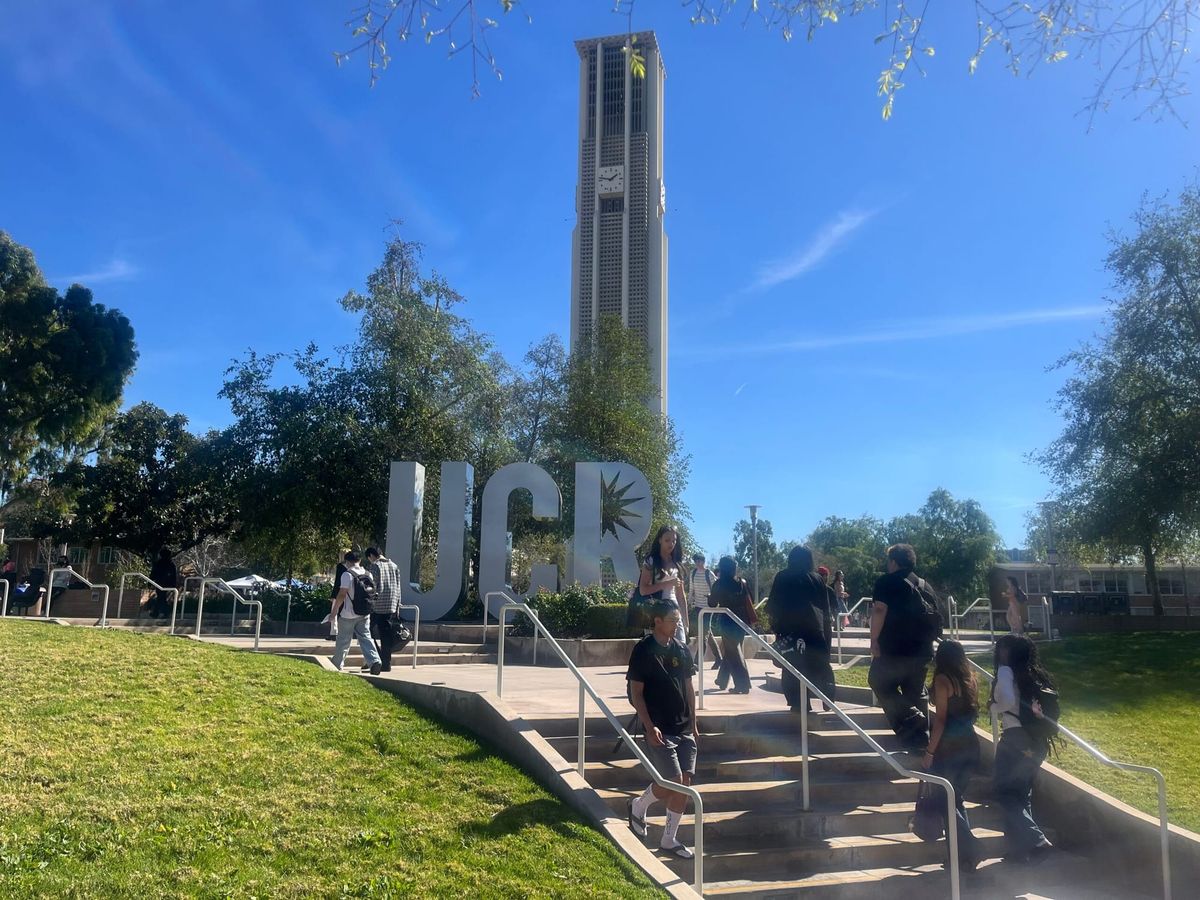
At UC Riverside — where roughly 1 in 5 students in introductory math failed, withdrew or received a D last school year — more students are entering campus taking math fundamentals courses, a level below precalculus.
“This creates a domino effect, with freshmen now taking precalculus starting in winter or spring quarters. Historic data shows taking courses out of sequence results in much higher failure rates,” campus spokesperson John Warren said.
The campus encourages students who need to start in the math fundamentals class to take it in the summer before their freshman year. Riverside has also expanded peer mentoring, tutoring and supplemental instruction for students with the least math preparation.
Warren also noted that the UC system is “exploring math courses that are aligned to students’ study disciplines.”
One such example is at UCLA, where some students take a math course in UCLA’s life sciences college instead of a traditional calculus course in the math department.
The class, “Mathematics for Life Scientists,” is tailored specifically to students in UCLA’s various biology programs, said Eric Deeds, a professor of integrative biology and physiology.
Failure and withdrawal rates in the class are lower than the systemwide average in calculus courses. Students who complete the course often perform better in subsequent chemistry and physics courses than students who took calculus, according to data shared by Deeds.
The reason the course works for many students, Deeds said, is because it “teaches mathematics that is really relevant for the students,” including using math to analyze real-world problems.
One lesson asks students to consider an ecosystem with a predator species of sharks and a prey species of tuna. Students are then tasked with using mathematical modeling to determine what will happen to the shark and tuna populations.
“Those are questions that students in our class find really interesting,” Deeds said. “We get students hooked on the idea that we need this math to be effective as scientists.”
The course is expanding within the UC system. The Santa Cruz campus recently added a class within its math department that is modeled after the UCLA class, and early results in student outcomes “appear promising,” according to a report to the UC Regents.
Deeds, who said he is “deeply concerned” about math readiness among UC enrollees, said he thinks nontraditional courses like the life sciences one could be part of the solution.
“I wouldn’t say that this is the only remedy to this problem. I think that there’s a lot of work to be done,” he said.

Editor's Note: The portion of the story covering the Capistrano Unified School District was added by Jeannette Andruss of Spotlight Schools.