
The Issue of Students Using Artificial Intelligence in School
As the popularity of Generative A.I. explodes, and districts race to regulate its use, our Editorial Intern explores what Los Alamitos High School students and teachers think.

It’s a common sight in classes at Los Alamitos High School. Teachers and students frequently see a student who uses Artificial Intelligence for an assignment.
“I see a lot of A.I,” LAHS senior Alyssa Zavala shared in an interview. “I feel like everybody uses it at this point.”
Alyssa said she’s noticed this emerging pattern over the years at the campus in the Los Alamitos Unified School District. “My sophomore year it started getting way popular,” she said.
A recent poll of 50 LAHS students conducted on the The Griffin Gazette's Instagram account offers more insight: 44% percent of those polled said they used A.I. on an assignment while 33% said that they have seen other students use A.I. on assignments.
Multiple students we spoke with concur. Some stated teachers have caught classmates using A.I. on assignments for English and Advanced Placement Chemistry, for instance. But they were uneasy discussing the topic.
In an era when A.I. guidelines can vary from classroom to classroom, many interviewees requested that their names not be used in the story as they didn’t want to get anyone in trouble. Some teachers allow the use of A.I. tools in classes, others forbid its use, students shared.
According to the high school’s latest handbook, a student is cheating if they: “Exchange assignments by printout, digital, electronic, or recorded means, and then submit as ‘original’ work. This includes, but is not limited to, cell phones, smart watches, paper or digital documents, and documents written using artificial intelligence tools.”
But we’re also learning that change is coming.
Brief History of A.I. LAHS
The A.I. chatbot ChatGPT first appeared for public use in 2022, a little more than three years ago. Since then, A.I. technology has exploded. Countless other A.I. platforms have debuted, some more powerful than others. This story focuses on the academic applications of the technology that students might use; from crafting complete essays in seconds, checking for grammar, answering complex math equations, to tailored tutoring.
“We already know that A.I. in schools is about more than just the adoption of a new technology. It signals a transformative shift in how we educate our students, and there’s no choice but to embrace it,” Orange County’s Superintendent of Schools, Stefan Bean, Ed.D., wrote in 2024.
He also wrote that the Orange County Department of Education set a target of 2025 for “90 percent of local districts to adopt ethical A.I. guidelines that promote responsible use across all educational settings.”
Similarly, a 2023-24 Orange County Grand Jury Report on the Use of Artificial Intelligence in Public Schools (K-12) concluded that local TK-12 schools “should implement policies and guidelines regarding the appropriate use of A.I.” by June 2025, including training teachers and students on the appropriate use of A.I.
That effort is still developing for many O.C. districts, and schools, as students and teachers encounter more products utilizing A.I. According to the O.C. Grand Jury Report published in 2024, just three districts out of the 22 that responded to its findings reported having an "overarching policy" governing A.I. use in classrooms at all schools. Los Alamitos USD was among the 19 without such a policy.
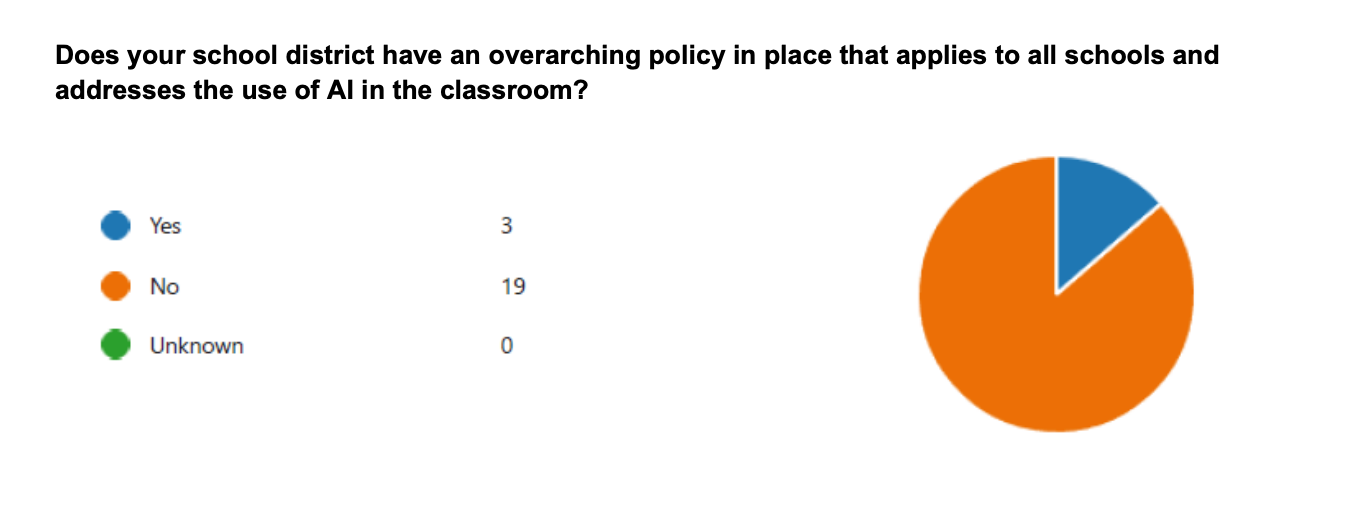
Last month, Superintendent Andrew Pulver, Ed.D., announced that the district is forming an A.I. committee that will have teachers from the elementary, middle and high school level. The goal is to develop an A.I. policy for the district's nine campuses.
“The focus of our work is how teachers and students can appropriately use A.I. tools,” Dr. Pulver told attendees at a PTA District Council meeting. “We want to make sure students and staff are using A.I. responsibly and ethically.”
This follows Dr. Pulver and the district’s response to the O.C. Grand Jury report in 2024 that stated that last school year, “K-12 teachers, education specialists, counselors, school psychologists, and administrators were trained on the appropriate use of A.I., including necessary precautions regarding ethics and data safety.”
Taking it back to January 2024, in a Griffin Gazette article, Deputy Superintendent Ondrea Reed talked about the need to educate students about the use of A.I. for career-readiness. “As A.I. becomes more prevalent in various industries, incorporating A.I. literacy and skills in the curriculum may become vital in preparing students for the future workforce,” Reed said.
A.I.: Harmful or Beneficial for Students?
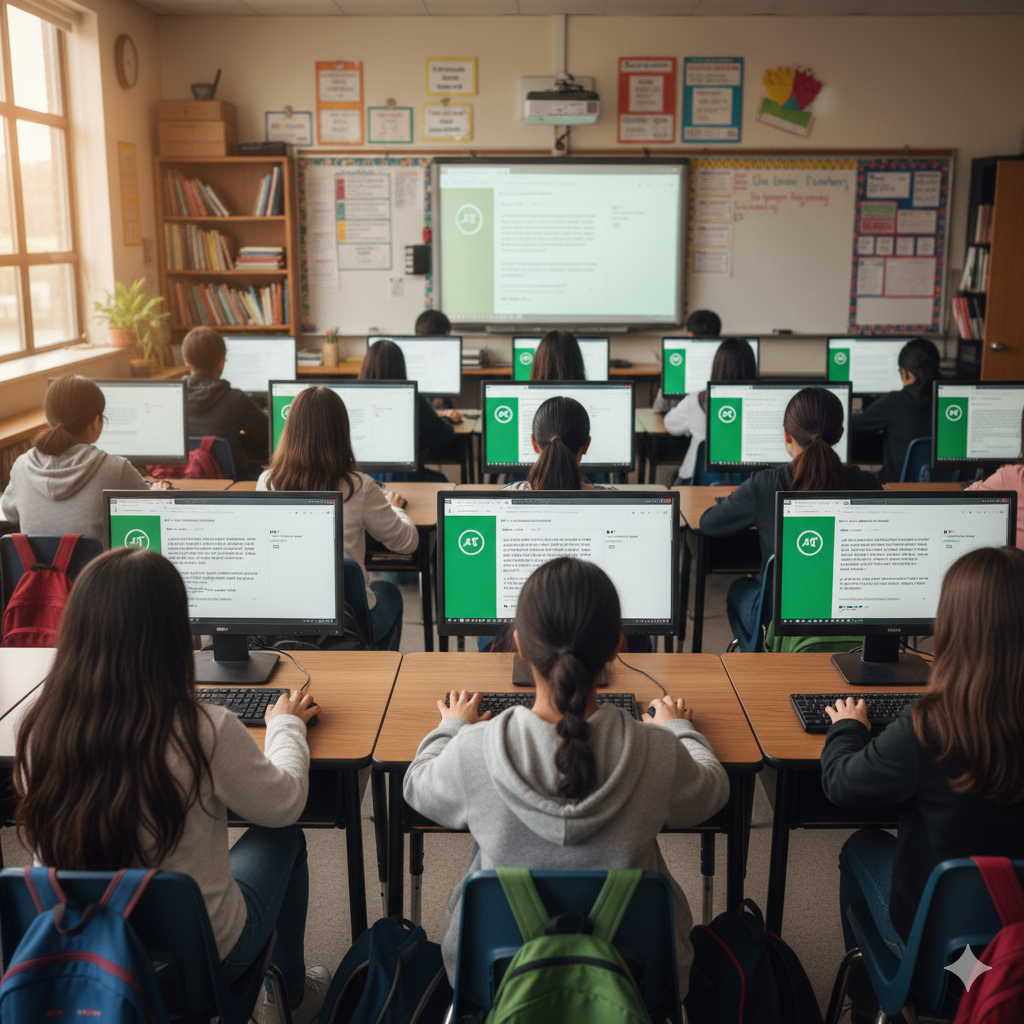
According to interviews, LAHS students and teachers think A.I. tools have the potential to be helpful, but can easily be used in a way that may be detrimental to learning.
Juniors Erin Martin and Kayleigh Garcia and sophomores Makenna Lucas and Olivia Nordstrom all agree that A.I. can destroy original thinking and creativity in assignments.
LAHS English teacher Samantha Williams believes that students are using A.I. tools to avoid work potentially inhibiting them from actually learning and understanding the material.
“The negative end is just using (A.I.) as a replacement for the work that they’re supposed to be creating themselves,” Williams said. “It can create the work, the product, for you, and there is no creativity there, because someone else is doing it, or something else is doing it for you.”
An LAHS math teacher also brings up another point, stating that A.I. can decrease thinking. “I have very strong opinions … I don’t know if they are well informed…but I think students using A.I. on assignments can decrease their thinking. If students rely on A.I. they are getting dumber,” she said, asking that her name not be used.
In addition, some students are concerned A.I. can be used in an unethical and unfair way. “A.I. is okay if it is used for grammar, but if it is used for cheating it's unfair,” said an LAHS sophomore who did not want to be identified.
Arguments for A.I.
Other students believe that A.I. tools, including ChatGPT and other chatbots can ultimately be helpful academic tools.
“It can help you in a way if you don’t understand something or you’re stuck, if you don’t copy word for word then it doesn’t destroy creativity. I use it to help me and give me more ideas in my own way,” said an LAHS junior who asked not to be identified.
Former LAHS student Rylee Robles advocated for the adoption of more A.I. tools when she was a senior last school year. She spoke at the Student A.I. Convening led by the O.C. Department of Education where 450 students talked about how A.I. could improve educational paths as well as increase understanding from technology.
“I think (A.I.) is more of a way to elevate your work than completely doing your work for you,” Rylee said in a 2024 Griffin Gazette article.
LAHS English teacher Williams is also inclined to agree with the helpfulness of A.I., in certain aspects.
“In a positive way that I’m seeing, especially this year, is test prep,” Williams said, noting that across the board she is seeing students ask chatbots to generate multiple choice questions to practice. “I think that it can be used in a positive way as a jumping off point, giving someone ideas on how to approach a project and using what they give you and making it your own… If you’re using it as a starting point and then you’re building upon it, then no, I don’t think it kills creativity,” said Williams.
Like a lot of technology, it often moves faster than regulations and rules. Educators and students we spoke with agree that A.I. isn’t going anywhere and that school districts are going to need to catch up to get a handle on it.
Williams appears hopeful. “I think they’re coming out with better ways to manage the use of A.I.”
Editor's Note: An earlier version of the story had the incorrect first name for Alyssa Zavala on the second reference. Additional reporting contributed by Jeannette Andruss.
This article was written by Spotlight Schools Editorial Intern Amelia Gutierrez, a student at Los Alamitos High School. Help support the Spotlight Schools internship program that inspires and trains young journalists by donating to Spotlight Schools here.